
The film and television industry is changing faster than its development models.
Producers are no longer searching for ideas.
They’re searching for finished intellectual property that can move immediately, attach talent cleanly, and enter production without creative or legal friction.
That demand has given rise to a new acquisition model in scripted content:
White-label screenplays.
This page explains what white-label screenplays are, how they work in film and television, how they differ from other script types, and why they are quickly becoming one of the most efficient ways to acquire premium, producible IP.
The White-Label Phenomenon
What Is a
White-Label Screenplay?
In film and television, a white-label screenplay is a fully developed, original script sold with complete ownership rights, allowing the buyer to produce, adapt, rename, or rewrite the material without attribution, creative obligation, or ongoing involvement from the original writer.
In simple terms:
You buy the script
You own the IP
You control the future of the project
Once acquired, the screenplay is removed from public availability and becomes the buyer’s asset to develop, package, or produce as they see fit.
White-Label Screenplays vs. “White-Label” in Other Industries
The term white-label already exists in software, marketing, and e-commerce, where it typically refers to customizable products resold under a different brand.
White-label screenplays are fundamentally different.
They are not:
Templates
Stock story frameworks
AI-generated concepts
Shared licenses
They are original narrative intellectual property, created to be sold outright, with a clean chain of title and no residual creative entanglement.
This distinction matters, both legally and strategically, and it’s why white-label screenplays appeal specifically to producers, financiers, and studios.
How White-Label Screenplays Work
The process is intentionally simple.
A screenplay is written as original, standalone IP
The script is offered privately for acquisition
The buyer purchases full ownership rights
The IP is transferred and removed from circulation
The buyer may:
Change the title
Rewrite or adapt the material
Attach talent
Pitch or produce without attribution
Position the project as original development
There are no residual obligations, no backend claims, and no required creative collaboration unless explicitly negotiated.
The result is speed, clarity, and control.
Why White-Label Screenplays Are the Future of Development
The industry is experiencing development fatigue.
Thousands of pitches compete for limited attention
Buyers are overwhelmed with half-formed concepts
Talent wants scripts they can step into immediately
Streamers demand speed, clarity, and scalability
White-label screenplays meet this moment.
They shift development from concept speculation to asset acquisition.
Instead of asking, “Can this be written?”
Buyers ask, “Can this move?”
Ownership replaces negotiation.
Execution replaces debate.
As the market becomes more compressed, white-label IP offers a direct path from acquisition to production, especially for limited series, contained features, and actor-driven vehicles.
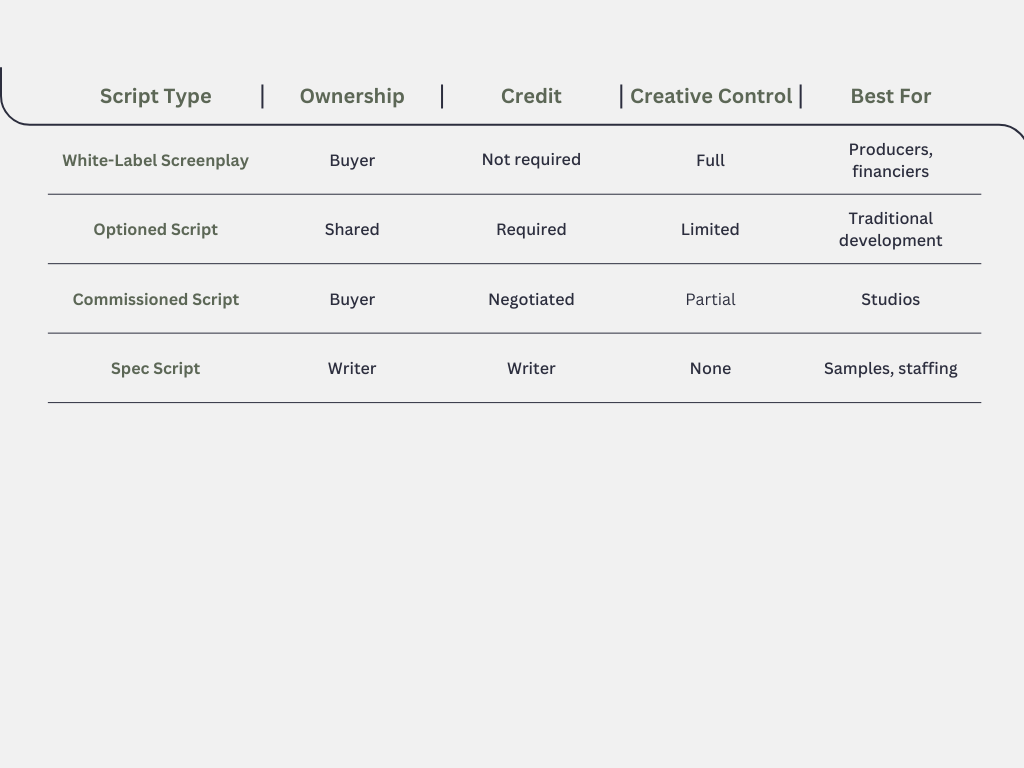
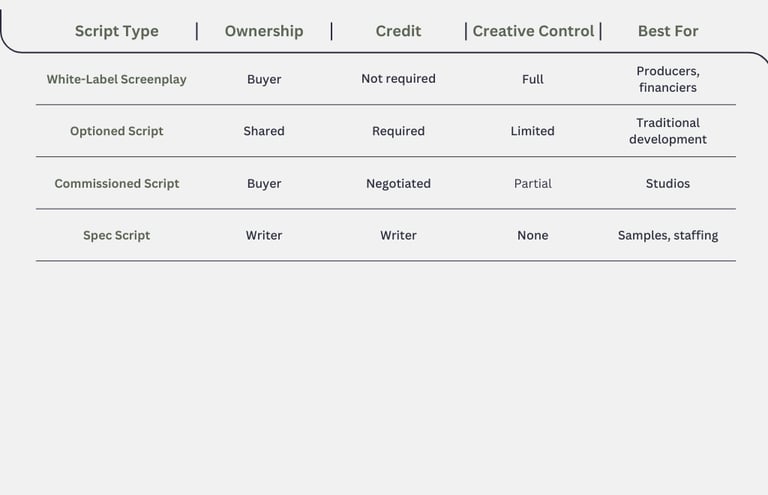
White-Label Screenplays vs. Other Script Types
White-label screenplays are not replacements for every development model but for buyers seeking speed, control, and ownership, they are often the most efficient option.
Who White-Label Screenplays Are For
White-label screenplays are ideal for:
Independent producers
Production companies
Actor-led production vehicles
International buyers
Streamers seeking fast-track development
Financiers looking for producible IP
They are particularly effective for:
Limited series
Contained features
Prestige drama
Character-driven projects
Budget-conscious productions
How Ripe Melland Media Approaches White-Label Screenplays
White-label does not mean generic.
Every white-label screenplay offered through Ripe Melland Media is:
Fully written and production-ready
Structurally sound and actor-driven
Designed with budget awareness
Built for prestige platforms and modern audiences
Offered in limited availability
Never AI-generated
Never recycled or templated
These are curated assets, not catalog filler.
Each script is written to stand on its own and to disappear into a buyer’s slate once acquired.